

Since the first confirmed detection of an exoplanet orbiting a sun-like star in 1995, astronomers have discovered thousands of worlds beyond our solar system. These exoplanets have revolutionized our understanding of planetary formation and the potential for life in the universe. Some of these distant worlds are so bizarre that they challenge our imagination and push the boundaries of what we thought possible in planetary science.
HD 189733b: The planet where it rains glass sideways
Discovered in 2005, HD 189733b is a “hot Jupiter” located 63 light-years from Earth. This gas giant orbits its star at a fraction of the distance between Mercury and our Sun, resulting in scorching temperatures of around 1,000°C (1,832°F). Its most striking feature, however, is its weather. Howling winds, blowing at speeds up to 5,400 mph (8,700 km/h), whip silicate particles high into the atmosphere where they condense into glass and then rain down sideways.

PSR B1620-26 b: The “Methuselah” planet
Also known as “Methuselah,” PSR B1620-26 b is one of the oldest known exoplanets, estimated to be about 12.7 billion years old—almost triple the age of Earth. Discovered in 1993, this gas giant orbits two stars: a pulsar and a white dwarf. Its extreme age and unusual binary star system provide valuable insights into the longevity of planetary systems and their ability to survive stellar evolution.

TrES-2b: The darkest known planet
TrES-2b, discovered in 2006, is darker than coal, reflecting less than 1% of the light that falls on it. This Jupiter-sized planet orbits its star at a distance of just 3 million miles, making it extremely hot. Scientists speculate that its atmosphere might contain light-absorbing chemicals like vaporized sodium or potassium, or gaseous titanium oxide, contributing to its incredibly dark appearance.

J1407b: The “Super Saturn”
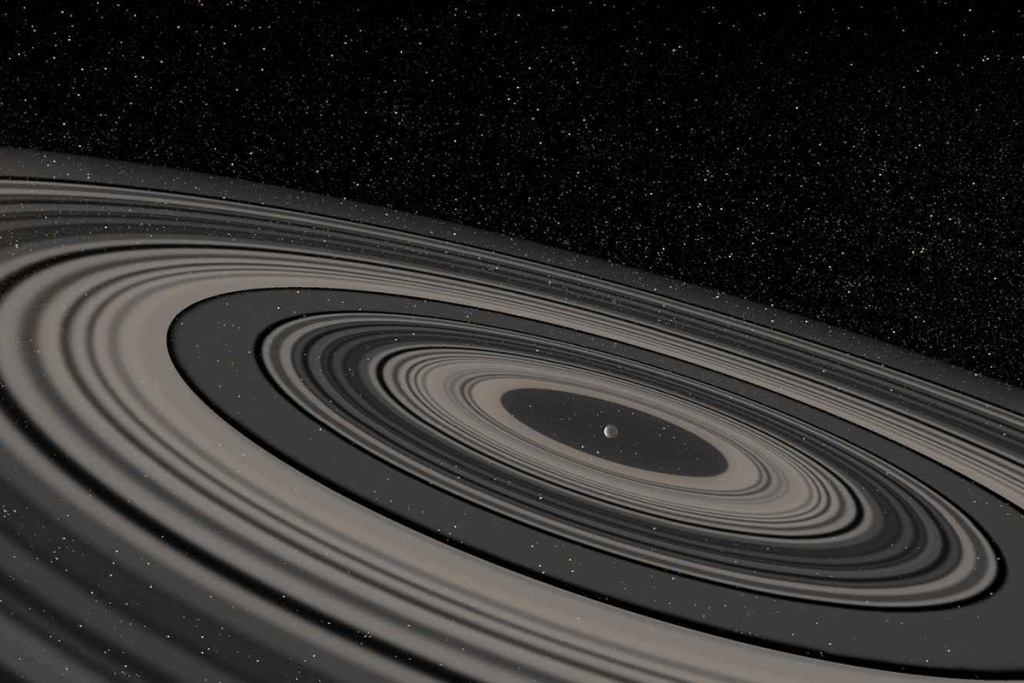
J1407b, discovered in 2012, is a planet with a ring system that puts Saturn to shame. Its rings are about 200 times larger than Saturn’s, spanning a diameter of approximately 90 million miles. If this planet were in our solar system, its rings would be visible from Earth, appearing larger than a full moon in the night sky. This massive ring system provides astronomers with a unique opportunity to study planetary ring formation and evolution.
WASP-12b: The planet being devoured by its star
WASP-12b, discovered in 2008, is a hot Jupiter that’s being torn apart by its parent star. The planet orbits so close to its star that it completes an orbit in just 26 hours. This proximity causes extreme tidal forces that are stretching the planet into an egg shape and pulling away its atmosphere at a rate of 6 billion metric tons per second. Astronomers estimate that the planet may be completely consumed within 10 million years, offering a rare glimpse into the end stages of a planet’s life.

Methods to detect exoplanets
Astronomers use several methods to detect and study exoplanets:
- Transit Method: Observing the dimming of a star’s light as a planet passes in front of it.
- Radial Velocity Method: Measuring the “wobble” of a star caused by an orbiting planet’s gravitational pull.
- Direct Imaging: Capturing actual images of exoplanets using advanced telescopes.
- Gravitational Microlensing: Detecting planets by observing how their gravity bends light from distant stars.
- Astrometry: Precisely measuring a star’s position in the sky to detect the influence of orbiting planets.
Implications for our understanding of planet formation
The discovery of these strange worlds has dramatically expanded our understanding of planetary formation and evolution:
- Diversity: The wide variety of exoplanets suggests that planet formation is a more diverse process than previously thought.
- Planetary Migration: Many hot Jupiters, like HD 189733b, indicate that gas giants can migrate close to their stars, challenging traditional models of solar system formation.
- Extreme Environments: Planets like TrES-2b show that worlds can form and persist in conditions vastly different from those in our solar system.
- Longevity: The existence of ancient planets like PSR B1620-26 b demonstrates that planetary systems can survive for billions of years, even through dramatic stellar evolution.
- Dynamic Systems: Planets like J1407b with its massive ring system reveal that planetary systems can be far more dynamic and complex than our own.
The search for habitable worlds on exoplanets
While these bizarre exoplanets are fascinating, a primary goal of exoplanet research is to find potentially habitable worlds. The discovery of strange planets helps in this search by:
- Refining detection methods: Techniques honed on extreme worlds can be applied to finding more Earth-like planets.
- Expanding the “habitable zone” concept: Unusual planets challenge our understanding of where life might be possible.
- Understanding planetary evolution: Studying diverse planets helps us understand how Earth-like planets might form and evolve.
- Characterizing atmospheres: Techniques used to study hot Jupiter atmospheres can be adapted to analyze potentially habitable world atmospheres.
The discovery of these strange exoplanets has transformed our understanding of the universe. From worlds darker than coal to planets with enormous ring systems, these bizarre celestial bodies challenge our preconceptions and expand our cosmic horizons. As we continue to explore the galaxy, we’re likely to find even stranger worlds, each offering new insights into the incredible diversity of planets in the universe. These discoveries not only fuel scientific advancement but also ignite our imagination, reminding us of the vast, unexplored wonders that await us in the cosmos.
FAQs about exoplanets
- How many exoplanets have been discovered so far?
As of 2024, over 5,000 exoplanets have been confirmed, with thousands more candidates awaiting confirmation. - Could any of these strange exoplanets support life?
Most of the exoplanets mentioned here are unlikely to support life as we know it due to extreme conditions. However, their study helps us understand where and how life might exist on other worlds. - What is the closest known exoplanet to Earth?
The closest known exoplanet is Proxima Centauri b, orbiting the star Proxima Centauri, about 4.2 light-years from Earth. - Can we see exoplanets directly through telescopes?
While most exoplanets are detected indirectly, some have been directly imaged using advanced telescopes. However, this is still challenging for most exoplanets due to their distance and the brightness of their host stars. - How do scientists determine the composition of exoplanets?
Scientists analyze the light passing through or reflecting off an exoplanet’s atmosphere to determine its composition, a technique called spectroscopy.
For more strange and unpredictable science curiosities, check out The Randomist’s Science and Technology feed!